
Serving the NICU’s Tiniest Patients:
How Human Milk Nutrition Helps Vulnerable Infants Thrive
As a proud member of the NICU Parent Network Industry Collective, Prolacta Bioscience is honored to share our commitment to supporting NICU families. Through our role as the world’s leading hospital provider of 100% human milk-based nutritional products for premature and critically ill infants, our focus is nourishing the most vulnerable infants in the NICU—those born weighing 1250 g or less. For these tiniest patients, optimal nutrition plays a vital role in healthy growth and development. Meeting the Unique Needs of Very Low Birth Weight Infants Very low birth weight (VLBW) infants, born as early as 22 weeks, face extraordinary challenges. Their first weeks of life may include respiratory distress from underdeveloped lungs, cardiac complications, and susceptibility to infections.1 Among the most serious threats is necrotizing enterocolitis (NEC), an often-fatal intestinal disease that may require surgical intervention.1 Fortunately, advancements in neonatal nutrition have enabled these vulnerable infants to not just survive but to thrive. Adoption of human milk-based fortifiers and formulas instead of the cow milk-based alternatives is transforming feeding practices in the NICU. In 2024 alone, Prolacta’s human milk-based nutritional products were used in over 50% of Level III and IV NICUs in the US for the smallest infants, including safety-net hospitals supporting underserved communities.2 Understanding “Human Milk Fortifiers” in the NICU Premature infants require 20% to 40% more calories and protein than full-term infants, which cannot be provided by mom’s own milk alone.3 To meet these enhanced nutritional needs, a fortifier must be added to mother’s own milk (MOM) or donor milk (DM) to provide preemies with the nutritional support needed for their survival, growth, and development. There are two kinds of “human milk fortifier” (HMF): cow milk-based and human milk-based (from donor breast milk). Both play an important role in meeting the nutritional needs of preemies during their stay in the NICU. However, in the smallest preemies, those born weighing 1250 g or less, cow milk-based fortifiers are known to increase the risk of complications, including NEC.4,5,13 It is in this extremely premature infant population that human milk-based nutrition has demonstrated the greatest benefits.4-13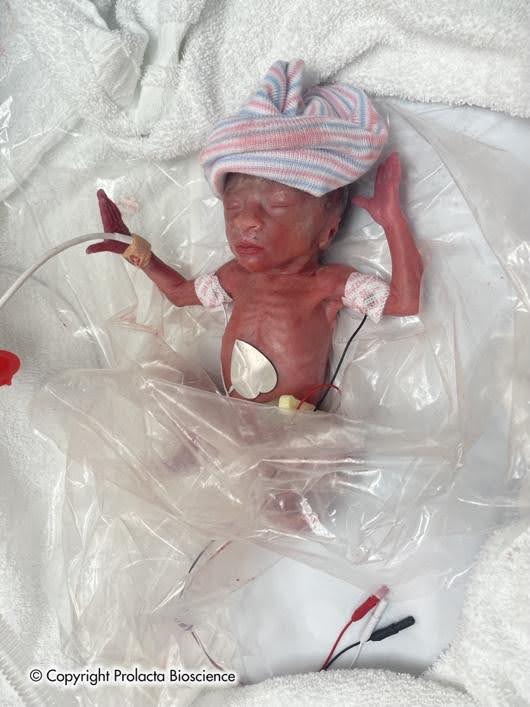
Baby Aria born at 27 weeks, weighing 630 g

Baby Aria post-NICU after receiving Prolacta products, 6 weeks adjusted weighing 2778 g
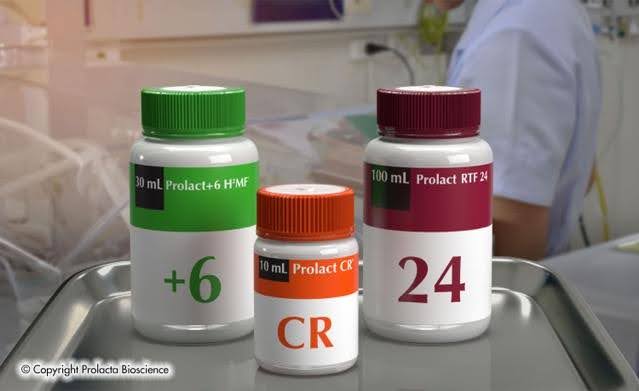
Prolacta’s nutritional products are made from 100% breast milk for premature infants born weighing 1250g or less.
Unwavering Commitment to Quality & Safety
To protect the medically fragile infants we serve, Prolacta developed and maintains the highest quality and safety standards in the human milk industry. It takes approximately 8-10 ounces of donor milk to produce just 1 ounce of Prolacta’s fortifiers, making our rigorous standards essential.
Our process begins with stringent qualification standards for the incredible mothers committed to helping critically ill and premature infants. Prolacta requires a Confirmation of Health certificate from both the mother’s physician and her baby’s pediatrician, verifying that both mom and baby are healthy and mom’s own infant is well-nourished. This ensures that there won’t be any compromise of the health of mom and her baby due to mom donating her excess milk. Additionally, we require that donors’ infants are fed 100% mother’s milk until they are 6 months, unless there is a medical reason preventing breastfeeding.
Following initial eligibility confirmation, each Prolacta donor is carefully screened via blood test, and a DNA swab is taken. Committed to the highest safety protocols, Prolacta was the first to adopt the safety measure of DNA matching to ensure all milk received comes directly from our carefully screened and vetted donors.
Once the donor milk arrives and is matched back to its screened donor, we test it for pathogens, viruses, adulterants, and presence of nicotine, marijuana, opiates, and other substances of abuse. Perhaps most importantly, Prolacta has spearheaded the direct testing of donor milk for harmful pathogens (including the virus that causes COVID-19) and other substances, such as traces of drugs or medications, using a technology known as nucleic acid amplification testing (NAAT). Prolacta is the first and only company in the human milk industry to apply NAAT to all donor milk received through our milk banks, leading the industry with unmatched quality, safety, and bioactivity.
Educating and Empowering Parents
Beyond our commitment to quality and safety, Prolacta is actively working to educate and empower NICU parents. We understand that the NICU’s complex medical environment can feel overwhelming, but we believe that knowledge is power. Armed with knowledge, parents can feel a sense of agency that can make this difficult time a little more bearable.
Infants receive the best care when NICU staff and parents work together. The cornerstone of this cooperative model is known as shared decision-making or family-centered care, where parents feel like informed partners in their infant’s care.
Parents know their infants, often better than the NICU staff, and their eyes and ears can be an invaluable resource. This doesn’t mean parents need to become medical experts. Instead, they need the confidence to voice their observations and participate in medical decisions affecting their child’s health and future.
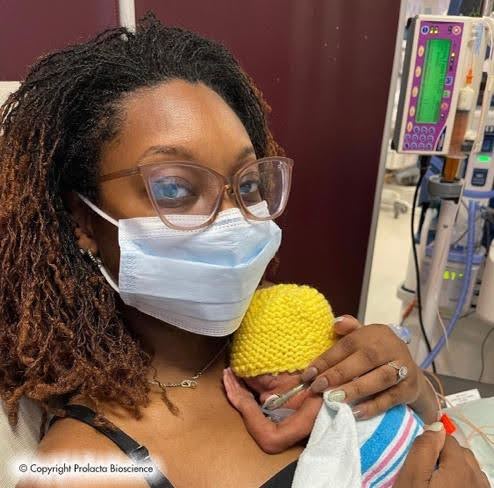
Mother Mya cuddles with her premature baby Aria in the NICU.
A busy NICU can be an intimidating place, but we encourage parents to engage with their infant’s care team, ask questions, and share their perspective. Through this collaborative approach, we can give these fragile preemies the best possible start in life.
We invite you to learn more about human milk-based nutrition for premature infants by visiting our parent education information at Prolacta.com.
References
- March of Dimes. Low birthweight. Updated June 2021. Accessed January 20, 2025. https://www.marchofdimes.org/find-support/topics/birth/low-birthweight
- Data on file; number of U.S. hospitals that used Prolacta’s fortifiers and formulas in 2024.
- Hair AB, Peluso AM, Hawthorne KM, et al. Beyond necrotizing enterocolitis prevention: improving outcomes with an exclusive human milk-based diet [published correction appears in Breastfeed Med. 2017 Dec;12 (10):663]. Breastfeed Med. 2016;11(2):70-74. doi:10.1089/bfm.2015.0134
- Hair AB, Peluso AM, Hawthorne KM, et al. Beyond necrotizing enterocolitis prevention: improving outcomes with an exclusive human milk-based diet [published correction appears in Breastfeed Med. 2017 Dec;12 (10):663]. Breastfeed Med. 2016;11(2):70-74. doi:10.1089/bfm.2015.0134
- Assad M, Elliott MJ, Abraham JH. Decreased cost and improved feeding tolerance in VLBW infants fed an exclusive human milk diet. J Perinatol. 2016;36(3):216-220. doi:10.1038/jp.2015.168
- Galis R, Trif P, Mudura D, et al. Association of fortification with human milk versus bovine milk-based fortifiers on short-term outcomes in preterm infants: a meta-analysis. Nutrients. 2024;16(6):910. doi:10.3390/nu16060910
- Bergner EM, Shypailo R, Visuthranukul C, et al. Growth, body composition, and neurodevelopmental outcomes at 2 years among preterm infants fed an exclusive human milk diet in the neonatal intensive care unit: a pilot study. Breastfeed Med. 2020;15(5):304-311. doi:10.1089/bfm.2019.0210
- Lucas A, Boscardin J, Abrams SA. Preterm infants fed cow’s milk-derived fortifier had adverse outcomes despite a base diet of only mother’s own milk. Breastfeed Med. 2020;15(5):297-303. doi:10.1089/bfm.2019.0133
- Delaney Manthe E, Perks PH, Swanson JR. Team-based implementation of an exclusive human milk diet. Adv Neonatal Care. 2019;19(6):460-467. doi:10.1097/ANC.0000000000000676
- O’Connor DL, Kiss A, Tomlinson C, et al. Nutrient enrichment of human milk with human and bovine milk–based fortifiers for infants born weighing <1250 g: a randomized clinical trial. [Published corrections appear in Am J Clin Nutr. 2019;110(2):529. doi:10.1093/ajcn/nqz091 and Am J Clin Nutr. 2020;111(5):1112. doi:10.1093/ajcn/nqaa042] Am J Clin Nutr. 2018;108(1):108-116.
- Abrams SA, Schanler RJ, Lee ML, Rechtman DJ. Greater mortality and morbidity in extremely preterm infants fed a diet containing cow milk protein products. Breastfeed Med. 2014;9(6):281-285. doi:10.1089/bfm.2014.0024
- Cristofalo EA, et al. Randomized trial of exclusive human milk versus preterm formula diets in extremely premature infants. J Pediatr. 2013;163(6):1592-1595. doi:10.1016/j.jpeds.2013.07.011
- Sullivan S, Schanler RJ, Kim JH, et al. An exclusively human milk-based diet is associated with a lower rate of necrotizing enterocolitis than a diet of human milk and bovine milk-based products. J Pediatr. 2010;156(4):562-7.e1. doi:10.1016/j.jpeds.2009.10.040
- Gila-Diaz A, Arribas SM, Algara A, Martín-Cabrejas MA, López de Pablo ÁL, Sáenz de Pipaón M, Ramiro-Cortijo D. A review of bioactive factors in human breastmilk: a focus on prematurity. Nutrients. 2019;11(6):1307. doi:10.3390/nu11061307
- Ballard O, Morrow AL. Human milk composition: nutrients and bioactive factors. Pediatr Clin North Am. 2013;60(1):49-74. doi:10.1016/j.pcl.2012.10.002. PMID: 23178060; PMCID: PMC3586783.
- Liang N, Koh J, Kim BJ, et al. Structural and functional changes of bioactive proteins in donor human milk treated by vat-pasteurization, retort sterilization, ultra-high-temperature sterilization, freeze-thawing and homogenization. Front Nutr. Published online September 15, 2022;9. doi:10.3389/fnut.2022.926814
- Data on file.